From microphone to live alerts.
ACOUXIA learns the sound of your process, delivering accurate models trained on eight years of acoustic data.
Why pre-trained AI models
Signal processing calibrates one condition at a time, and each calibration requires an engineer. Pre-trained AI models learn many conditions together, and retrain in minutes as the process changes. Why that matters
A walkthrough of the seven steps from a first production recording to a live AI model. The models start pre-trained on eight years of acoustic data, then adapt to your process using your own recordings.
Factory floors are too noisy and unpredictable for traditional signal processing.
Digital signal processing (DSP) was built for predictable conditions in controlled settings. Production rarely behaves that way, so ACOUXIA uses AI models instead.
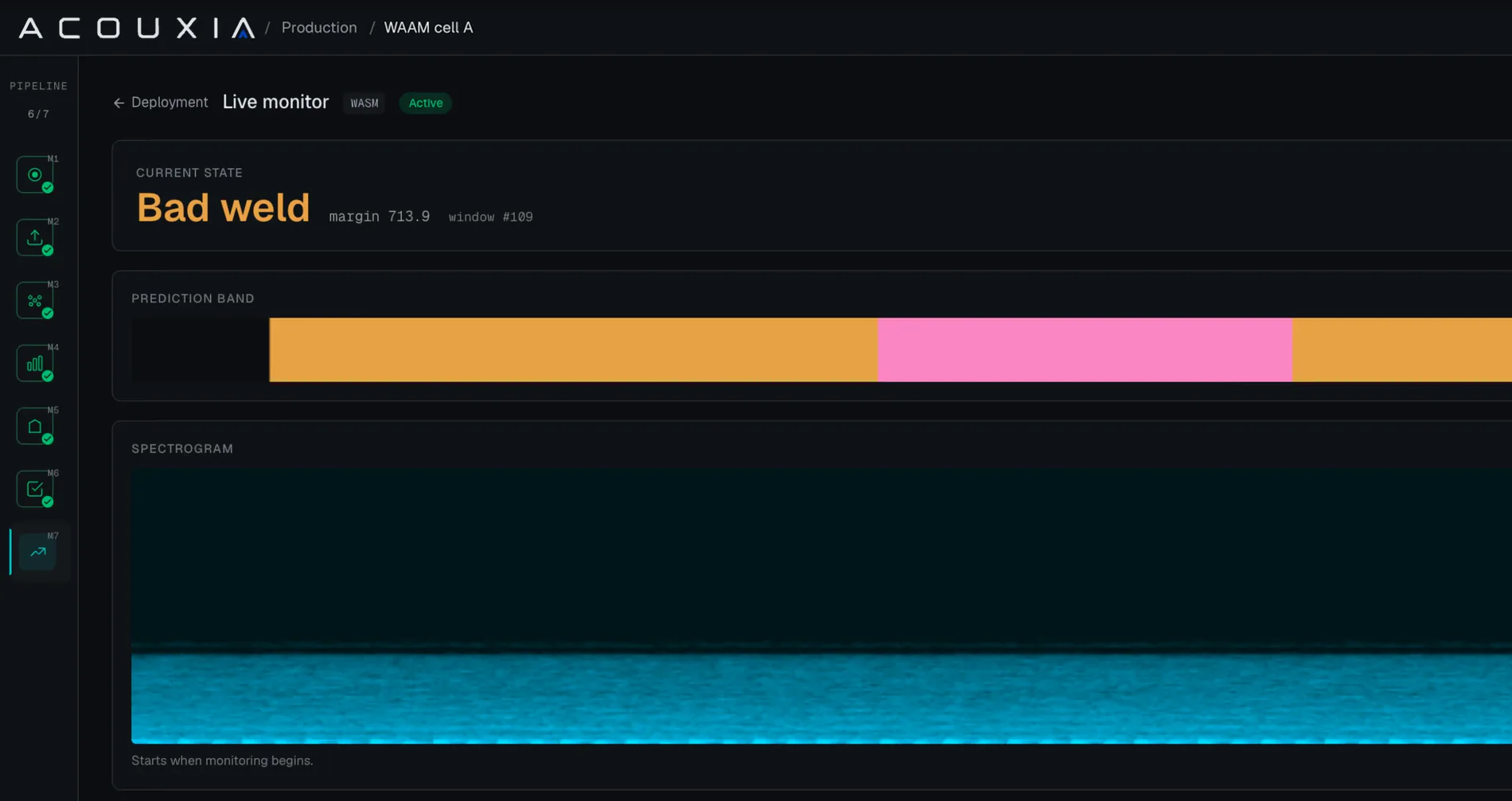
From first recording to live monitoring.
Seven steps to a live AI model.
Sign in and download the app.
Operating within a day.
Timing depends on your specific process. As a rule, once you have approximately 10 hours of recordings and about 5% of those capture faults, ACOUXIA can build a highly-accurate, production-ready model.
Processes where faults can be safely triggered during recording get there fastest.
What your team sees.
One alert, three uses.
Your process data stays protected.
Why recordings are uploaded
Your model is trained in the cloud, so recordings need to be uploaded. When you upload an audio file, we immediately convert it to anonymised data that can only be used within ACOUXIA.